

The Quiet Guilt of Everyday Parenting
It usually happened around 5:30.
The groceries were half on the counter, half still in the bags. Maya, my middle child, needed help with something small but urgent. Dinner hadn’t started yet. And my youngest child, Bryce, was standing there, watching me, waiting.
That was when the pressure would build and the guilt would creep in. The feeling that I should be interacting with my child. That if I handed them a screen so I could get through the evening, I was somehow neglecting them, or failing the day. I remember the frantic feeling of needing to get things done with a baby in my arms.
One day, before Kylie was even crawling, I remember plopping her in a shallow box on the kitchen floor, the kind that once held a delivery. I poured in plain, dry oats and added a few measuring cups, desperate for a distraction that would let me put together some semblance of dinner. She scooped, poured, sifted, and sometimes tasted. I stayed nearby, cutting and slicing as she happily explored, giving me the gift of time.
Looking back, that was when things began to change for me: realizing that my child didn’t need me to entertain them. They needed an invitation. The Oat Box was one of the earliest invitations I discovered—safe, sensory, and open-ended—and it carried the same quiet power as everything that followed.
Years later, when I encountered KWEST through Tarrell’s work, I recognized that same idea—an approach rooted in trusting children, offering simple invitations, and letting learning live through movement, sound, mark-making, and imagination inside real life.
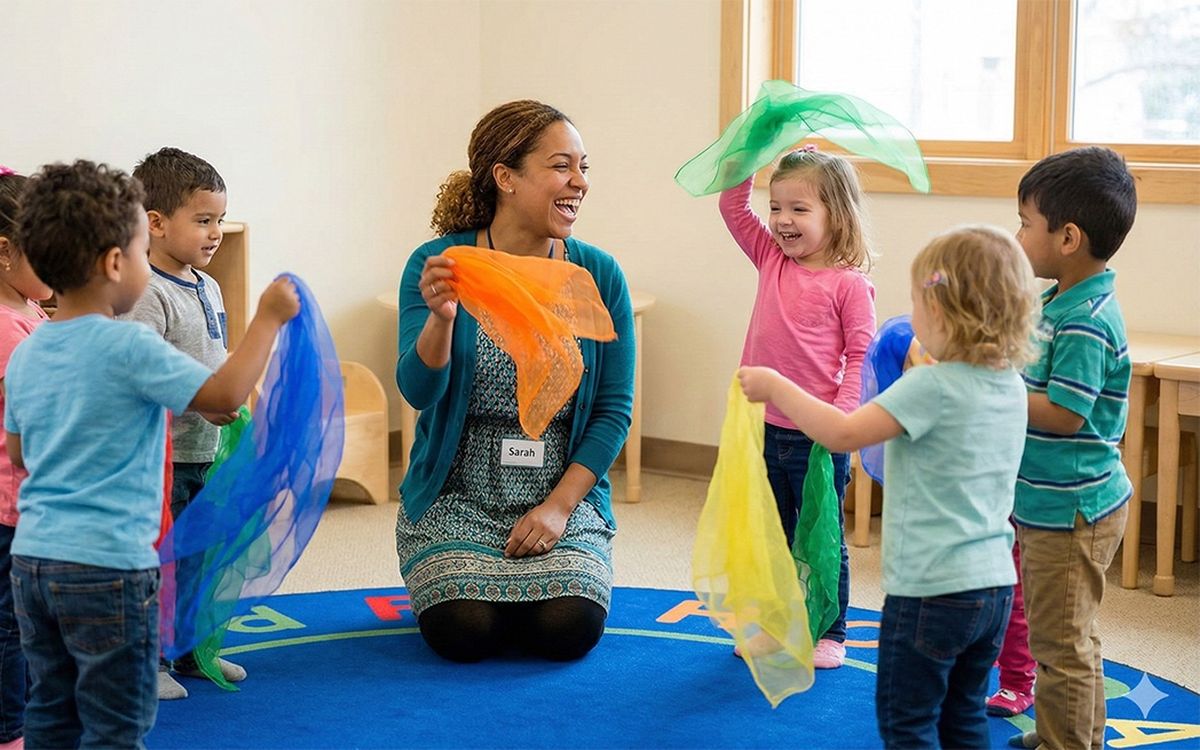
As my family grew, so did the hecticness of our lives. One afternoon, instead of saying, “Hold on, I’ll play with you in a minute,” I pulled a small basket off the shelf. Inside were a few scarves—nothing fancy. I slid it across the floor and said, “You can choose one.”
That was it.
Kylie sorted through, looking for the one that was most like fairy wings. Maya picked a red scarf. Bryce chose another. They waved them. They tied them around their arms. They dragged one across the floor while I finished unloading groceries. No directions. No expected outcome. Just movement.
What that basket gave me wasn’t a quiet child. It gave me space. And it gave my children something even better: Initiative. Ownership. Camaraderie. And what followed was even better—laughter, connection, imagination taking flight. In those moments, their creativity didn’t need prompting. It emerged on its own, turning ordinary fabric into stories only they could see. Years later, I could see how that same creative thinking showed up again and again when they faced challenges and figured things out on their own.
Once I noticed it, I started to see how often moments like that appeared across a day—and how easy it was to support them without stopping everything else.
In the mornings, when I was getting Kylie or Maya ready and needed ten uninterrupted minutes, I set out differently sized papers, stamps, and thick markers on the table before I started. Not as an activity. Just as an option. Sometimes it became a drawing. Sometimes it became scribbles and stories. Sometimes it became nothing at all, and that was okay.
Around lunchtime, I was usually cooking, making something on the stove. One day Bryce, who had ADHD and was in constant motion, pulled a pot and spoon off the counter. Things like this always happened with him. A moment turned into a mess. I learned to use these inevitable outcomes as invitations of sorts. After wiping down the floor and picking up the pot, I had him stand beside me, stirring air. I didn’t stop what I was doing. I didn’t unleash fury. I redirected, telling him, “You’re stirring like me.” If he couldn't stand still, which was often, he'd spin his body in circles as I stirred the soup. We were doing different things, but we were together and the tension created by his continuous kinetic frenzy dissipated.
That was when it clicked for me: learning had been happening in the middle of real life all along, and that is what KWEST captures. Not from adding more to the day, but from noticing what children are already capable of when given space, materials, and trust.
Later in the afternoon, when energy dipped, we found ways to get moving. Sometimes we walked like animals from one room to the next. Sometimes we carried groceries one item at a time and sorted them on the counter. Sometimes socks became a matching game while laundry was folded. None of it was planned. All of it mattered.
Evenings slowed things down. We noticed the light outside. “It’s darker now,” I would say. We talked about what came first in the day and what came next. We watched shadows change across a day. We described the leaves with "beautiful words” that became poems that captured the moments. Not as a lesson—just us noticing together.
What surprised me most was how my kids changed.
They stopped asking, “What should I do?” as often. They didn’t need constant direction. They returned to the same materials again and again—the scarves, the papers, the blocks—and each time they used them differently.
And the guilt faded.
Because I could see that my children hadn’t been waiting for me to perform. They had been learning how to enter the world with confidence.
KWEST, an online early childhood learning platform for educators and parents, is built on this idea—one developed through years of work with young children and families—of creating open-ended arts-integrated experiences children can enter independently while life continues around them.
Looking back, I didn’t need more time. I didn’t need to do more. Sometimes all it took was a small basket, placed within reach, a creative spark offered, and the willingness to let my kids take it from there.
Explore KWEST’s Independent Invitations treasure for simple ways to offer these kinds of moments at home.