

Philadelphia’s Settlement Music School goes national with its arts preschool
From Philly and the Pa. suburbs to South Jersey and Delaware, what would you like WHYY News to cover? Let us know!
Want your kids to be 60% happier, with five times less stress and triple the vocabulary? The Settlement Music School in Philadelphia’ Queen Village has just what you are looking for.
Settlement’s preschool program, Kaleidoscope, generates those “astonishing” results in young children, according to child psychologist Dr. Ellie Brown, director of West Chester University’s Early Childhood Cognition and Emotions Lab, who has been studying Settlement’s Kaleidoscope school for 20 years.
“It was a ‘wow’ moment,” Brown said about when she started to understand Kaleidoscope’s results.
The school now is offering the program for teachers and homeschoolers everywhere with an online teaching platform, KWEST.
“As an applied developmental scientist, I study factors that might influence child development every day, and most programs don’t have much of an impact,” she said. “But when you find something that really has a profound positive impact like the program here at Settlement, you want the world to know about it.”
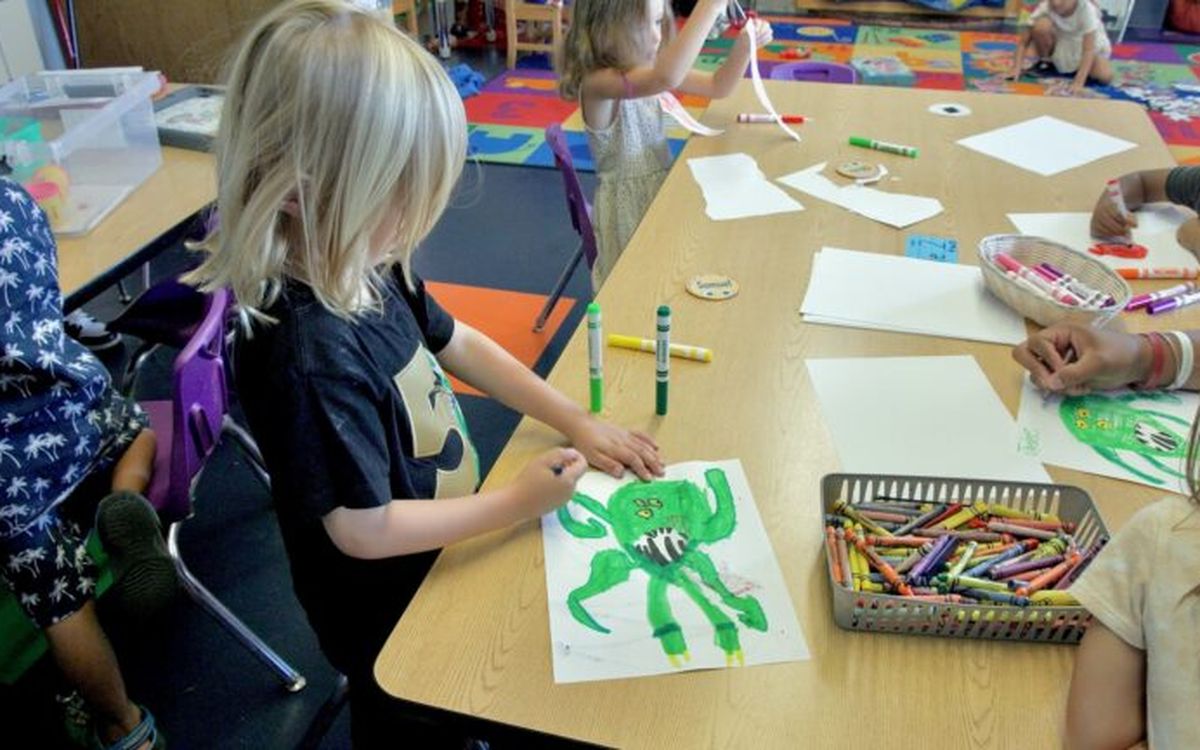
Kaleidoscope teaches very young children the basic skills needed to start school, such as spatial and social awareness, recognizing patterns, and how to follow directions and act in groups. The school reinforces those skills with music, dance and art.
Tarrell Davis, Settlement’s director of early childhood programs, said different children learn differently.
“If a child doesn’t grasp what a pattern is in music class, where they’re using a cadence to learn about patterns, they may need their whole body to learn about what a pattern is,” said Davis. “Creative movement is where they would grasp what that concept is.”
‘Unparalleled’ results in children
On a recent day, in creative movement class, teacher Kaye Fernandez took about 20 children through an improvised dance, then sat them down and pulled out a jointed wooden doll. She pointed out the doll’s arms, legs, elbows and hands and asked her students to shake their corresponding body part.
“Can you move your arm?” Fernandez said to enthusiastic confirmation from her young students. “What else? Another body part.”
“Hands!” a child shouted.
“Hands! Can you wave?” Fernandez responded. “That is moving your body, because that is a body part.”
To a typical observer, this may seem simple. Brown, however, is a clinical psychologist and sees a lot going on.
“All early childhood teachers integrate the arts to some extent, maybe a song to teach days of the week or drawing during a particular time of day. But at Settlement, that integration is intensive and systematic,” she said. “It’s really unparalleled. We know that children learn best when the entire body is engaged and events are registered by multiple senses. That’s one of the things we think is driving the profound impact on school readiness.”
Making arts integrated education available online
Settlement is now making Kaleidoscope preschool teaching methods available to anyone through the online platform KWEST, or Kaleidoscope Wants Everyone Succeeding Together. The website features simple ways to use artmaking, dance and music to teach basic school readiness skills.
The Early Cognition Lab helped Settlement distill the techniques into what Brown called “active ingredients” that are then incorporated into lesson plans. Those techniques include mimicking insect sounds to develop a sense of pattern and repetition, painting with removable adhesive tape to see how actions can change an outcome and rearranging anthropomorphic letters to create new words with new meanings.
The website is intended to guide teachers, parents and childcare workers through lesson plans; children are not expected to interact with the website.
What if you don’t have a dozen conga drums on hand to teach music with? KWEST can suggest that kids drum on tabletops or on their own bodies. What if you don’t have a dance studio, or easels and art supplies? Davis designed KWEST to be as flexible as possible to meet teachers where they are, with what they have.
“A lot of programs that work with Early Head Start and PhillyPre-K, they get federal money, and with federal money you have to be using a certain curriculum,” she said. “That’s why [KWEST] is not called a curriculum. It’s an online learning platform so that teachers don’t feel like they have to use this, and this, and do all of these things. They can just choose what curriculum they’re using, and KWEST will pull up activities that align with what they’re already doing.”
Settlement has made generational impact
Settlement is a highly respected, widely known music school that was established in 1908. Kaleidoscope was established in 1990. The school was literally in the shadow of the notorious, now-demolished Southwark Plaza towers, then regarded as one of the most troubled housing projects in the city.
“At that time, folks in the immediate community were worried about other things: Food, jobs, that type of thing,” Davis said. “[CEO Robert Capanna] surveyed the neighborhood to find out what the school could provide that the immediate community could be useful for them, and it was child care.”
“Why not create a preschool and teach children through the arts, this being a music school?” she said. “I mean, it was brilliant.”
The Early Cognition Lab studies put hard data behind the belief that Settlement’s use of the arts improved learning. Dianna Kelly didn’t have to be convinced. She sent her five children there, despite the fact that it was not near their home in South Philadelphia. Kelly would spend about 15 minutes driving her kids to Settlement every day.
“It was at first,like, ‘Oh, wow, this is really far,’ but once I learned about the program and seeing what they have, I would have walked through snow to get there,” she said.
“They would create the coolest things that would excite me, art projects and they would do their shows, the dances they’d learn. I had my son Damian doing the bachata with this little girl,” she said. “I have the cutest memories in my phone and my mind of my children shining, just sparking little kids, their confidence and their excitement for school.”
Kelly’s daughter, Faith Valentine, is now 22 and has a daughter of her own, Lucia. Valentine sent Lucia to Settlement for preschool.
“She was learning a lot, it definitely built her character,” Valentine said. “She’s very smart, very confident.”
“She has the confidence to dance. Some music comes on and she will shake it. That’s Miss Kaye,” Kelly said, referencing dance teacher Fernandez. “Miss Kaye is a great teacher. I’ve been with her for 24 years with my children and my granddaughter now.”
Davis originally intended to publish the KWEST teaching methods as a book, but opted for an online portal when she learned how flexible and rich a website could be. The KWEST portal is a subscription model. The monthly rate for a classroom is $10, for individuals it is $7. Davis wanted to keep it inexpensive and accessible.
“How can we get this in every teacher’s hand, every adult that works with children to tap their creativity, and say, ‘By using movement in this way, or visual art in this way, or music or all of them together, is really impactful?’” she said. “All children need to have this opportunity.”
Editor’s Note: This story is part of a series that explores the impact of creativity on student learning and success. WHYY and this series are supported by the Marrazzo Family Foundation, a foundation focused on fostering creativity in Philadelphia youth, which is led by Ellie and Jeffrey Marrazzo. WHYY News produces independent, fact-based news content for audiences in Greater Philadelphia, Delaware and South Jersey.